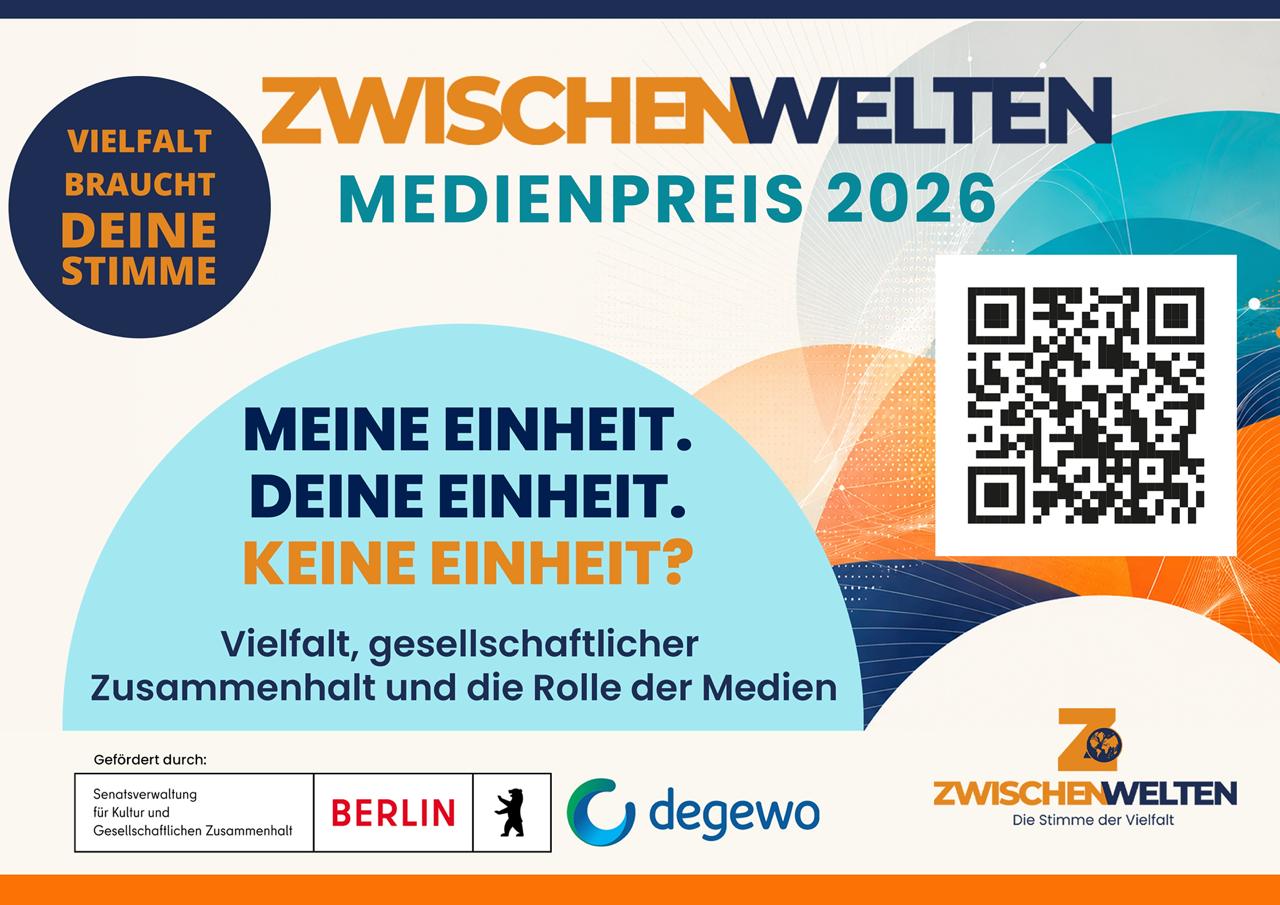
How can journalism strengthen social cohesion? Which stories foster participation rather than polarization? How can Germany's diverse lived realities be made visible in the media? What role does religion play in better coexistence? How are East and West continuing to grow together? These are the questions behind the Zwischenwelten Media Award 2026, presented for the first time this year. The award recognizes journalistic and media work that engages with diversity, democratic participation, and the role of media in a pluralistic society. Applications are open until September 15, 2026. The award ceremony will take place on October 3 — German Unity Day — in Berlin.
A new media award for a new Germany
Germany in 2026 looks markedly different from Germany in 1990. Thirty-six years after reunification, the question of social cohesion is once again pressing. Different lived experiences, cultural backgrounds, religious convictions, and political views shape public discourse — and are often portrayed as a threat to social cohesion. Yet the media carry a particular responsibility here: they can provide orientation, build bridges between social groups, and strengthen democratic participation — or deepen existing conflicts and fuel polarization.
More than a buzzword
The new media award honors journalism in the post-migrant society. The term describes a social reality in which migration has long ceased to be a marginal phenomenon and has fundamentally shaped Germany. In a post-migrant society, the question is no longer whether people with a history of migration belong — it is how people with different cultural, religious, and social experiences shape life together.
The Zwischenwelten Media Award therefore treats the post-migrant society not as a political slogan but as a social reality and a journalistic mandate. It aims to encourage media professionals to tell stories that make different perspectives visible, question prejudice, and strengthen democratic dialogue. At its center are contributions that provide orientation, build understanding, keep the common good in view, and strengthen social cohesion.
„Social cohesion doesn't happen on its own. It needs journalism that listens, explains, and makes different lived realities visible. With the Zwischenwelten Media Award, we want to encourage media professionals to tell stories that build bridges and give space to the contributions of every part of society."
Süleyman BağProject lead of „Zwischenwelten – Die Stimme der Vielfalt"
Stories that broaden perspectives
The award is looking for journalistic work that reports with nuance, opens up new perspectives, and makes a constructive contribution to democratic public discourse and the common good — whether a feature on volunteer work, a podcast on different generations living together, a documentary on religious diversity, or a multimedia project on new forms of social participation. What matters is work that brings people into dialogue with one another and shows how cohesion can succeed in an increasingly diverse society.
„Journalism should do more to make the diversity of an urban society visible. It's at the neighborhood level, in particular, that stories emerge showing how people live together and take on responsibility despite differing experiences. These perspectives deserve more attention and recognition."
Dominique HenselEditor-in-chief of Brunnenmagazin
Open to a broad range of participants
Eligible to apply are journalists, writers, bloggers, podcasters, filmmakers, and students of media-related fields, as well as citizen media, community media outlets, and media initiatives. The only requirement is a connection to Berlin — either through the applicant's place of residence or work, or through the subject matter of the submission.
Eligible formats include newspaper and magazine articles, online articles, features, interviews, essays, podcasts, video and film productions, multimedia formats, and journalistic content for social media.
Themes of our diverse society
The competition welcomes work engaging with current social challenges, including:
- social cohesion in a diverse society
- the role of media in democracy and participation
- understanding between different social groups
- perspectives on a post-migrant society
- religion, humanism, and social cohesion
- peace and dialogue, and
- visions for Berlin's future
Eligible are works published between January 1, 2025 and August 31, 2026.
„Journalism carries a special responsibility for democratic public discourse. Those who carefully research different perspectives, put facts in proper context, and give voice to a range of viewpoints lay the groundwork for an informed public debate. The Zwischenwelten Media Award sends an important signal for responsible, quality journalism in a society oriented toward the common good."
Prof. Dr. Sabine SchifferMedia scholar, director of the Institute for Media Responsibility, and jury member
Jury and prize money
The jury evaluates submissions on journalistic quality, originality, social relevance, diversity of perspective, and their contribution to democratic debate, dialogue, and understanding.
The media award carries a total prize fund of 3,000 euros, distributed as follows:
The jury may also award honorable mentions and special commendations.
The jury includes figures from journalism, academia, culture, and civil society:
- Dominique Hensel (editor-in-chief, Brunnenmagazin)
- Süleyman Bağ (project lead, Zwischenwelten)
- Prof. Dr. Sabine Schiffer (Institute for Media Responsibility)
- Bernd Lammel (photojournalist)
- Kerstin Nickig (filmmaker)
- Iskender Sezek (journalist in exile)
Applications open until September 15
Submissions can be emailed to Medienpreis@zwischenwelten.berlin between July 1 and September 15, 2026.
Required materials include the submission itself or a link to it, a brief description (max. 300 words), contact details, and proof of a connection to Berlin.
The award ceremony will take place on October 3, 2026, in Berlin.
About the project
The Zwischenwelten Media Award is part of the project „Zwischenwelten – Die Stimme der Vielfalt" („Zwischenwelten – The Voice of Diversity"). The intercultural media, culture, and education project is run by Kubik e.V., the Evangelical Church congregation at Gesundbrunnen, and journalists Dominique Hensel and Andrei Schnell.
The project's goal is to strengthen democratic public discourse, social participation, and dialogue in a diverse urban society. It is funded by the Berlin Senate Department for Culture and Social Cohesion and the municipal housing company degewo.
An award with a signal effect
With the Zwischenwelten Media Award, Berlin gains its first award specifically dedicated to journalism in the post-migrant society. At a time of growing social polarization, the award aims to spotlight stories that foster understanding, connect different lived worlds, and enrich democratic debate. In doing so, it is not just a recognition of outstanding journalistic work — it is also an impulse for journalism as a whole.